Vampire: The Masquerade TTRPG PDF ― A Comprehensive Guide

Vampire: The Masquerade, originating from White Wolf Publishing, heavily influences modern vampire lore. PDF resources offer access to this rich, dark world,
spanning rules, chronicles, and supplemental materials for tabletop roleplaying.
Vampire: The Masquerade is a tabletop role-playing game (TTRPG) initially developed by White Wolf Publishing as part of their “Old World of Darkness” line. Its enduring legacy stems from a compelling blend of gothic horror, personal drama, and political intrigue, profoundly impacting popular culture’s depiction of vampires. The game distinguishes itself by moving beyond simple monster hunting, focusing instead on the internal struggles and societal complexities of immortal beings navigating a hidden world.
The availability of Vampire: The Masquerade in PDF format has significantly broadened its accessibility. These digital versions encompass core rulebooks, sourcebooks detailing various vampire clans and sects, and supplemental materials offering expanded storytelling options. PDFs allow players and Storytellers (game masters) to easily access and utilize the game’s extensive lore and mechanics. The game’s influence is so pervasive that many contemporary vampire tropes trace their origins back to its established setting and rules. Early translations of the term “vampire” into Japanese, for example, demonstrate its long-standing cultural presence, even predating modern interpretations.
The core experience revolves around players embodying vampires, grappling with their monstrous nature, maintaining the Masquerade (concealing their existence from humanity), and navigating the treacherous politics of vampire society.
II. Understanding the Core Concepts
At the heart of Vampire: The Masquerade lies a complex interplay of several core concepts. Central is the Beast, the primal, predatory nature within each vampire, constantly threatening to overwhelm their humanity. Players must manage this inner darkness through willpower and adherence to their clan’s traditions. The Masquerade itself – the strict code of secrecy – is paramount, demanding vampires conceal their existence from mortal eyes to avoid exposure and potential destruction.
Blood is both sustenance and a source of power, dictating a vampire’s capabilities and vulnerabilities. Different bloodlines possess unique properties, influencing a vampire’s strengths and weaknesses. Generations define a vampire’s age and potency; older vampires (lower generation) are generally more powerful but also more susceptible to the Beast.
PDF versions of the rulebooks meticulously detail these concepts, providing players with the necessary framework to understand the game’s intricate mechanics. Accessing these resources digitally streamlines gameplay, allowing for quick reference during sessions. The game’s setting, rooted in gothic horror and political maneuvering, is further illuminated through supplemental PDFs, enriching the immersive experience. Understanding these fundamentals is crucial for both players and Storytellers seeking to navigate the World of Darkness.

III. The Masquerade and its Importance
The Masquerade is the foundational law governing vampire society in Vampire: The Masquerade. It’s the collective effort to conceal the existence of vampires from humanity, a necessity for survival. Breaching the Masquerade carries severe consequences, ranging from censure by the vampire courts to final death (Diablerie). PDF rulebooks emphasize this principle, detailing the myriad ways vampires maintain secrecy – manipulation, influence, and, when necessary, brutal suppression of witnesses.
Maintaining the Masquerade isn’t merely about avoiding detection; it’s about preserving a fragile status quo. Exposure would invite hunters, religious zealots, and governmental agencies, leading to widespread persecution. The Camarilla, a dominant vampire sect, rigidly enforces the Masquerade, viewing it as essential for long-term stability.
PDF resources provide Storytellers with tools to implement Masquerade breaches into their chronicles, creating dramatic tension and challenging players to navigate complex ethical dilemmas. The consequences of failure are often dire, forcing characters to make difficult choices. Understanding the Masquerade’s nuances, as detailed in the game’s PDFs, is vital for creating a believable and engaging World of Darkness experience.
IV. Clans: Defining Vampire Society
Vampire: The Masquerade’s society is structured around Clans – families of vampires sharing a common lineage and unique characteristics. Each Clan possesses a specific weakness and a defining Discipline, shaping their role within the undead world. PDF sourcebooks dedicate extensive sections to detailing each Clan’s history, philosophies, and typical behaviors.
Clans like the Ventrue, traditionalist aristocrats, often dominate the Camarilla, while the Toreador, obsessed with beauty and art, indulge in mortal pleasures. The Brujah, rebellious and passionate, frequently align with the Anarchs. These inherent Clan tendencies influence character creation and roleplaying, providing a framework for compelling narratives.
PDFs outline the specific advantages and disadvantages of each Clan, impacting character abilities and social interactions. Understanding Clan weaknesses – like the Malkavian’s madness or the Nosferatu’s hideous appearance – is crucial for navigating the political landscape. The Clan system, thoroughly explored in the game’s PDFs, adds depth and complexity to the World of Darkness, fostering intricate power dynamics and compelling character arcs.
V. Character Creation
Character Creation in Vampire: The Masquerade, detailed extensively within the core rulebook PDFs, is a multi-stage process. It begins with selecting a Clan, which immediately defines certain attributes and predispositions. Players then distribute points among core Attributes – Physical, Social, and Mental – representing inherent capabilities.

Following Attributes, players allocate points to Abilities, representing learned skills like Brawl, Persuasion, or Occult. The PDF guides players through selecting Backgrounds, reflecting a character’s mortal life and providing resources, and Advantages & Disadvantages, adding unique quirks and challenges.
Crucially, character creation involves choosing a Nature and Conduct, defining inner desires and outward behavior. Finally, players select Disciplines – supernatural powers unique to their Clan – shaping their vampiric abilities. PDFs provide clear instructions and character sheets to streamline this process, ensuring players create compelling and individualized vampires ready to navigate the World of Darkness. Careful consideration of each step is vital for a fulfilling roleplaying experience.

VI. Attributes and Abilities

Attributes in Vampire: The Masquerade, thoroughly explained in the core rulebook PDFs, are fundamental character statistics. These fall into three categories: Physical (Strength, Dexterity, Stamina), Social (Charisma, Manipulation, Appearance), and Mental (Perception, Intelligence, Wits). Each Attribute is rated on a scale, influencing success in various actions.
Abilities, detailed alongside Attributes in the PDFs, represent learned skills and training. These are linked to Attributes; for example, Brawl uses Strength + Dexterity. Abilities include areas like Combat, Social, Technical, and Knowledge skills. A character’s proficiency in an Ability is determined by a skill rating.
The interplay between Attributes and Abilities is central to the game’s mechanics. When attempting an action, players roll dice modified by relevant Attribute and Ability scores. PDFs provide extensive lists of Abilities and clear guidance on how they interact with the game system, allowing players to build well-rounded and capable characters.
VII. Disciplines: Supernatural Powers
Disciplines are the core of vampiric power in Vampire: The Masquerade, comprehensively detailed within the various PDF rulebooks and supplements. These represent the supernatural abilities granted by the Embrace, the act of becoming a vampire. Each Clan typically has favored Disciplines, though characters can learn others.
Disciplines are categorized into areas like Dominate (mind control), Potence (physical strength), Celerity (speed), Fortitude (resilience), and Obfuscate (concealment). PDFs outline each Discipline’s powers, ranked by levels, requiring experience points to unlock. Higher levels grant more potent effects.
Using Disciplines consumes Blood, a vital resource for vampires. Careful management of Blood is crucial, as overuse can lead to vulnerability. The PDFs provide detailed rules for Discipline use, Blood expenditure, and the risks associated with tapping into these dark powers, forming a cornerstone of character progression and gameplay.
VIII. The World of Darkness

The World of Darkness, as presented in Vampire: The Masquerade PDF resources, is a gothic-punk setting steeped in mystery and hidden conflicts. It’s a reflection of our own world, but shadowed by the supernatural – a place where monsters lurk beneath the surface of modern society.
PDFs detail a world where ancient beings, like vampires, werewolves, and mages, vie for power and influence. Humanity remains largely unaware of this hidden reality, protected (and manipulated) by the supernatural entities. The setting emphasizes personal horror, moral ambiguity, and the struggle for survival.
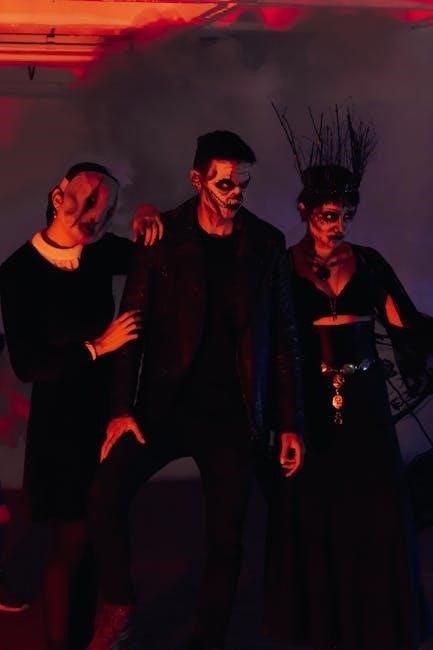
The core concept revolves around the “Masquerade” – the vampires’ collective effort to conceal their existence from humanity. Breaching the Masquerade carries severe consequences. PDFs provide extensive lore on the history, geography, and political landscape of this dark and dangerous world, offering Storytellers rich material for crafting compelling chronicles.
IX. Sects: Camarilla, Sabbat, and Anarchs
Vampire: The Masquerade PDF materials extensively detail the major vampire sects, each with distinct ideologies and practices. The Camarilla, often called the “Ivory Tower,” prioritizes tradition, secrecy, and maintaining the Masquerade through rigid social structures and political maneuvering. PDFs outline their complex hierarchy and laws.
In stark contrast, the Sabbat embraces its monstrous nature, rejecting humanity and reveling in predatory freedom. PDFs reveal their brutal rituals, pack-based organization, and open defiance of the Masquerade. They represent a more savage and chaotic path for vampires.
The Anarchs, a more recent development, represent a rebellion against the established order. PDFs showcase their diverse motivations, ranging from genuine liberation to simple self-interest. They challenge the authority of both the Camarilla and Sabbat, offering a more independent, though often unstable, existence.
X. Geographic Regions and Cities
Vampire: The Masquerade PDF sourcebooks dedicate significant detail to the World of Darkness’s geography, particularly focusing on cities as focal points of vampire activity. Early materials heavily featured locations like New York, Los Angeles, and London, each presented with unique political landscapes and historical backgrounds. PDFs provide detailed city maps, key NPC information, and chronicle ideas tailored to specific locales.
Eastern European settings, drawing from Balkan folklore, are also prominent, reflecting the game’s origins. These regions often feature older, more powerful vampires and a more primal struggle for dominance. Later PDFs expanded the scope to include cities across the globe, from Tokyo to Buenos Aires, each reflecting local cultures and supernatural influences.
PDFs often highlight the importance of a city’s history and its impact on the vampire population, detailing ancient covenants and forgotten secrets. Understanding these regional nuances is crucial for immersive storytelling.
XI. Gameplay Mechanics
Vampire: The Masquerade PDFs detail a system built around storytelling and character interaction, utilizing a dice pool mechanic. Players assemble a pool of ten-sided dice (d10s) based on Attributes and Abilities, aiming to roll 8 or higher on each die. The number of successes determines the outcome of an action. PDFs clearly outline these rules, including modifiers for difficulty and situational factors.
The core mechanic extends to combat, which is presented as dangerous and often a last resort. PDFs emphasize the narrative consequences of violence, reflecting the Masquerade’s need for secrecy. Beyond basic skill checks, PDFs explain the use of Disciplines – supernatural powers unique to each vampire Clan – and how they impact gameplay.
PDFs also cover the Hunger mechanic, representing a vampire’s constant need to feed, and its influence on behavior and self-control. Managing Hunger is a central element of the gameplay experience.
XII. Dice Rolling and Skill Checks
Vampire: The Masquerade PDFs detail a dice pool system utilizing ten-sided dice (d10s). Players construct a pool by combining a relevant Attribute (e.g., Strength, Dexterity) with an applicable Ability (e.g., Brawl, Stealth). The number of dice rolled directly correlates to the character’s proficiency.
Success is determined by rolling 8 or higher on each die. Each successful die represents a success; the more successes, the better the outcome. PDFs provide detailed charts and examples illustrating this process. Difficulty modifiers, ranging from simple to heroic, adjust the number of successes required.
PDFs emphasize that failures aren’t always absolute. Dramatic failures can introduce complications, while marginal successes might come with a cost. Furthermore, PDFs explain how to utilize special dice – 10s are often treated as two successes – adding an element of luck and potential for exceptional results.

XIII. Combat System
Vampire: The Masquerade PDFs present a narrative-focused combat system, prioritizing storytelling over strict tactical simulation; Combat revolves around opposed dice pools, pitting attacker’s relevant Attribute + Ability against the defender’s. Successes determine damage inflicted, though PDFs detail various defensive maneuvers like dodging and parrying.
Damage is abstracted into health levels – Bruised, Wounded, Injured, and Incapacitated – rather than hit points. PDFs clearly outline the effects of each level, impacting character actions. Supernatural Disciplines significantly alter combat, offering abilities like heightened speed, strength, or protective auras.
PDFs emphasize the importance of initiative, often determined by Dexterity + Alertness. Combat isn’t solely physical; social manipulation and psychological warfare are viable tactics. The system encourages Storytellers to describe combat vividly, focusing on the dramatic consequences of each action, rather than solely numerical results.
XIV. Storytelling in Vampire: The Masquerade
Vampire: The Masquerade PDFs empower Storytellers to craft immersive gothic-punk narratives. The core focus isn’t ‘winning,’ but exploring themes of power, morality, and the struggle for humanity. PDFs provide tools for chronicle creation, outlining methods for developing compelling plots and memorable NPCs.

Successful storytelling relies on establishing a strong atmosphere, emphasizing the clandestine nature of vampire society and the constant threat of exposure. PDFs detail the importance of player agency, encouraging Storytellers to react dynamically to player choices. Themes of personal horror, political intrigue, and existential dread are central.
PDF resources often include sample chronicles and advice on pacing, scene setting, and character motivation. Storytellers are encouraged to embrace improvisation and collaborate with players to build a shared narrative. The system thrives on dramatic irony and the exploration of complex character relationships.
XV. Chronicle Creation and Themes
Vampire: The Masquerade PDFs provide extensive guidance on chronicle creation, moving beyond simple adventure design. A chronicle represents an ongoing story, a tapestry woven from individual sessions. PDFs emphasize establishing a central premise – a core conflict or mystery – that drives the narrative forward.
Key thematic elements include the struggle to maintain humanity in the face of monstrous urges, the corrupting influence of power, and the complexities of vampire politics. PDFs suggest exploring themes of isolation, loss, and the search for meaning in a dark world. The ‘Masquerade’ itself – concealing vampire existence – is a constant, overarching theme.
PDF resources detail methods for developing compelling cities, outlining power structures, notable NPCs, and potential conflicts. Storytellers are encouraged to consider the chronicle’s scope – local, regional, or global – and tailor the narrative accordingly. Long-term planning and foreshadowing are crucial for a satisfying chronicle.
XVI. Running a Game: Tips for Storytellers
Vampire: The Masquerade PDFs offer invaluable advice for Storytellers (Game Masters). Mastering the rules is essential, but equally important is understanding the game’s tone – a blend of gothic horror, political intrigue, and personal tragedy. PDFs stress the importance of player agency, allowing characters to shape the narrative through their choices.
Embrace improvisation! Players will inevitably deviate from planned storylines. PDFs suggest preparing broad outlines rather than rigid scripts. Focus on creating a believable and immersive world, populated with memorable NPCs. Utilize atmosphere – descriptions of settings, sounds, and emotions – to heighten tension.
PDF resources highlight the need for managing the ‘Masquerade’ – ensuring players understand the consequences of exposure. Encourage roleplaying and character development, rewarding players for exploring their characters’ inner conflicts. Remember, Vampire: The Masquerade is about more than just combat; it’s about the struggle for survival and meaning.
XVII. Available PDF Resources
Numerous Vampire: The Masquerade TTRPG PDFs are readily available, catering to different editions and preferences. Official rulebooks, like the core Vampire: The Masquerade 5th Edition, are easily sourced digitally. Supplements expand the game world, introducing new clans, sects, and storylines – often found as downloadable PDFs.
Beyond official releases, a thriving third-party market offers a wealth of content. Websites and platforms host fan-created chronicles, adventures, and character sheets in PDF format. Tools like character builders and map editors are also frequently distributed as PDFs, streamlining gameplay.
However, caution is advised. Ensure PDFs are obtained from reputable sources to avoid pirated or corrupted files. Websites specializing in tabletop RPG PDFs often provide curated collections. Remember to check licensing terms for third-party content before use, respecting creators’ rights. Exploring these resources unlocks a vast library of Vampire: The Masquerade experiences.
XVIII. Official Rulebooks and Supplements
The foundation of any Vampire: The Masquerade game lies in the official rulebooks available as PDFs. The core Vampire: The Masquerade 5th Edition rulebook provides the essential mechanics and lore. Earlier editions, like Revised and 20th Anniversary Editions, are also widely available in PDF format, offering distinct gameplay experiences.
Supplements significantly expand the game’s scope. Titles like Clanbook series delve into the histories and unique Disciplines of each vampire clan. Sourcebooks explore specific cities (e.g., Chicago Folio) or themes (e.g., The Hunter’s Hunt). These PDFs enrich chronicle creation and provide Storytellers with diverse narrative tools.
Digital distribution allows easy access to these resources. Official websites and online retailers offer legitimate PDF purchases. Owning these PDFs ensures access to the most accurate and comprehensive rules, fostering a deeper understanding of the World of Darkness and enhancing the storytelling experience.
XIX. Third-Party Content and Tools
Beyond official releases, a vibrant community creates a wealth of third-party content for Vampire: The Masquerade, often available as PDFs. Websites and online forums host fan-made chronicles, character templates, and expanded lore materials. These resources can supplement official content, offering fresh perspectives and unique gameplay options.
Various digital tools aid Storytellers and players. Character sheet PDFs, often customizable, streamline character management. Worldbuilding tools and map-making software enhance chronicle creation. Some fans develop virtual tabletop (VTT) modules specifically for Vampire: The Masquerade, facilitating online play.
However, caution is advised. While much third-party content is excellent, quality varies. Always verify the source and ensure compatibility with your chosen edition; Respect copyright and licensing when utilizing fan-created materials. These tools, used responsibly, can significantly enrich your World of Darkness experience.
XX. Legal Considerations and PDF Acquisition
Acquiring Vampire: The Masquerade PDFs requires careful attention to legalities. Purchasing directly from official sources – such as DriveThruRPG or the Paradox Interactive website – ensures legitimate access and supports the game’s creators. Avoid downloading PDFs from unofficial or torrent sites, as this constitutes copyright infringement.
Older editions may present challenges. While some are readily available for purchase, others might be out of print. Checking authorized digital distributors is crucial. Be wary of “bundles” offered on unofficial platforms, as their legality is often questionable.
Understanding licensing terms is vital. PDFs typically come with usage restrictions, prohibiting unauthorized reproduction or distribution. Respecting these terms protects the intellectual property of Paradox Interactive and ensures continued development of the World of Darkness. Always prioritize legal acquisition methods to enjoy the game responsibly.
Comments